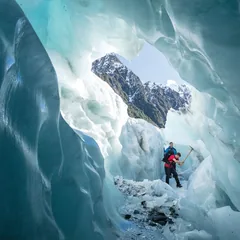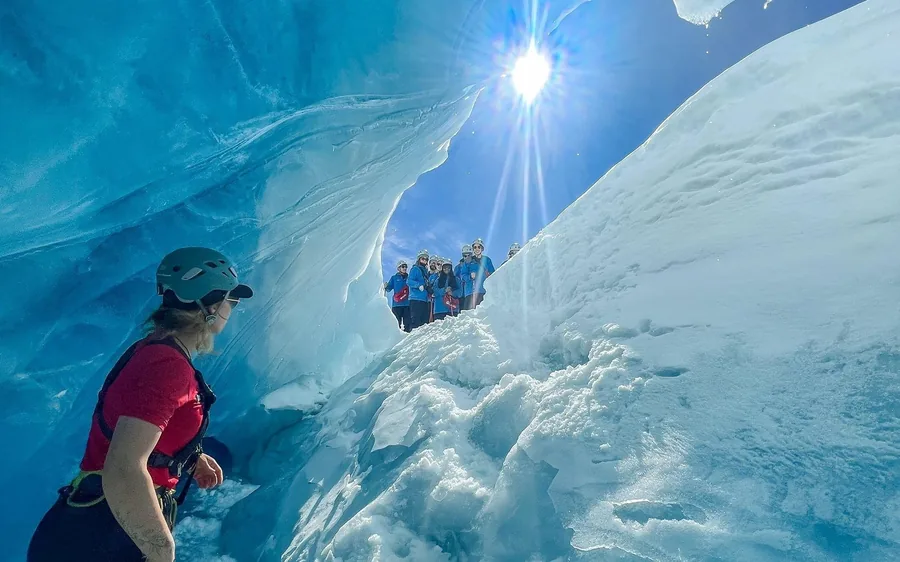
Our top pick398 reviews
4–8 h2.5-Hour Heli-Hike
★ 4.8 · 398 reviews
- 4 to 8 hours, on Franz Josef Glacier
- Helicopter transfer
- Most booked
- Free cancellation
$497$124.25 / hour
Check availability→ The photograph everybody wants
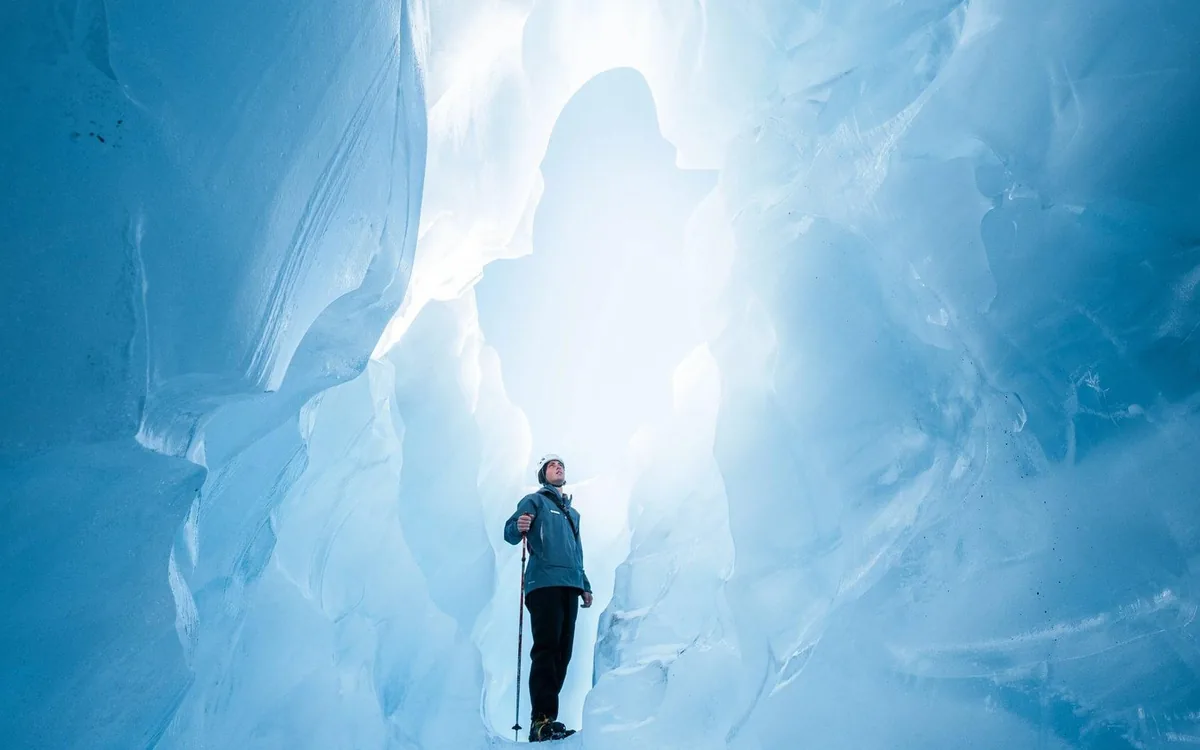
The image that sells this glacier is a person standing inside a blue tunnel with two metres of ice overhead. It is real, it is on Franz Josef, and it is the single most common disappointment here — because the tunnels are seasonal, they are never in the same place twice, and no operator can promise you one. This page explains what they actually are, when your odds are best, and what to do if there is not one on the day you go.
Quick answer
The short answer. The tunnels are carved by meltwater and they open and close continuously. Your best odds are February to April, on a guided heli hike, on the earliest departure of the day. Nobody can guarantee one. What is guaranteed is blue ice — the colour is everywhere on the glacier, not only inside a cave.
What they actually are
A glacier is a river that happens to be solid, and like any river it carries water. In summer the surface melts, the water finds a crack, and it works its way down and through the ice. Where that flow is strong enough and the ice around it is stable enough, it hollows out a passage.
That is a Franz Josef ice cave: a meltwater tunnel, not a rock cave. Which has three consequences that matter to you.
They are seasonal. Melt makes them. Late summer into autumn is when there is most water moving through the glacier and the most tunnels open. In spring the same features are buried under snow.
They move. The ice is flowing downhill continuously, so a tunnel that was there last week has been carried somewhere else, deformed, or closed. Guides find new ones and lose old ones constantly.
They are not always safe. A guide will only take a group into one that has been checked that morning. Some are simply looked at from outside, and that decision is not negotiable.
The blue
Lock white balance to daylight. Auto will fight you and win.
Glacier ice at depth has had almost all the air squeezed out of it by the weight above. Dense, bubble-free ice absorbs the red end of the spectrum and scatters the blue, so what comes back at your eye is a blue with nothing else in it.
Inside a tunnel the effect compounds: light enters from outside, travels through a couple of metres of ice, and arrives filtered. The result is not a tint. It is a room lit entirely in one colour.
Cameras handle it badly. Auto white balance reads the blue as a colour cast and tries to remove it, which is why so many people come home with photographs of a grey cave. Lock the white balance to daylight before you go in, and shoot wider than you think.
The other thing worth knowing: you do not need a tunnel for the blue. Crevasse walls, the sides of pressure ridges, and any freshly cut step all show it. On a good day the whole walk is blue.
Your odds
None of them is bookable, but four of them are choosable.
Late-summer melt is what opens tunnels. This is also the most settled flying weather of the year, which is a rare case of two things pointing the same way.
Tunnels are ground-level features inside the ice. No scenic flight can show you one, at any price. This is the single clearest reason to pay for the hike.
The guides who cut the route are up there at seven. The first group of the day walks the freshest route and gets the low light coming into the features.
A guide with four people can take them into a tunnel that a guide with eleven will look at from outside. The extended small-group day at $857 exists partly for this.
Anyone promising you an ice cave is selling something they do not control. What they can promise is a guide who knows where this week’s features are.
Deciding between the standard hike and the small-group day?
Which heli hike to book→Book direct
The standard heli hike and the small-group day, which has the better odds.
★ 4.8 · 398 reviews
★ 5.0 · 1 reviews
Common questions
Yes, but they are meltwater tunnels rather than permanent caves. They open and close as the ice moves and the melt changes, they are never in the same place twice, and they are only reachable on a guided heli hike.
No. They are above the icefall, and there has been no walking route onto the glacier since the terminal face collapsed in 2012. A scenic flight cannot show you one either — they are ground-level features inside the ice.
No, and no operator can honestly promise one. What the guides can do is know where this week’s features are and whether they are stable enough to enter. Some are walked through and some are looked at from outside.
February to April. Late-summer melt is what carves them, and those months also happen to be the most settled flying weather of the year. In spring the same features are buried under snow.
Deep glacier ice has had the air squeezed out of it. Dense, bubble-free ice absorbs red light and scatters blue, so what reaches your eye is blue with nothing else in it. Inside a tunnel the light passes through two metres of it and the effect compounds.
Lock white balance to daylight before you go in. Auto white balance reads the blue as a cast and removes it, which is why so many people come home with photographs of a grey cave. Shoot wider than you think and put a person in the frame for scale.
Go deeper
What it is, what it costs, and why there is no way onto the ice without one.
PricesThree heli hikes priced against the scenic flight, and what the money actually buys.
VerdictThree heli hikes compared on time on the ice, group size and what is included.
Hike or flyThe most common wrong booking in Franz Josef, settled with both sets of numbers.
Hour by hourFrom the boot fitting to the pick-up, in order, with the boring parts left in.
Which oneTwo glaciers, two villages, and which one to put your only clear morning into.